Global Social Commerce Market Overview:
Social commerce is a part of e-commerce, and refers to purchasing & buying activities that take place specifically on social networking sites. Social commerce comprises local and worldwide markets that contain small & major enterprises offering their items to various social media followers and individual shoppers.  To know about the Research Methodology :- Request Free Sample Report The report has covered the market trends from 2015 to forecast the market through 2026. 2019 is considered a base year however 2020’s numbers are on real output of the companies in the market. Special attention is given to 2020 and effect of lockdown on the demand and supply, and also the impact of lockdown for next two years on the market. Some companies have done well in lockdown also and specific strategic analysis of those companies is done in the report.
Global Social Commerce Market Dynamics:
A large number of social media users in the region gives benefits from the social commerce market growth. Due to the increasing number of social media users, retailers in the Asia-Pacific region are using social media platforms such as Facebook, Instagram, and Twitter to market their products. Although the growth of the social commerce market looks promising, concerns related to consumer data privacy will challenge industry growth. Retailers in this field use technologies such as artificial intelligence, big data, and blockchain to improve the customer buying experience. It plays a key role in promoting industry growth. The technologies are constantly changing, and use cases are still being explored in the field of social commerce. Therefore, the occurrence of privacy issues and cyber-attacks may hinder market growth to a certain extent. Artificial intelligence, online platforms, big data, virtual reality, blockchain technology, and virtual assistants are helpful for users in online shopping. As a result of these changes, the perplexity of privacy problems has grown. Because many social networking sites are not secured against cyber-attacks, users are concerned about illegal access to their information. Security problems are only temporary, as vendors/retailers collaborate with third-party payment processors to provide consumers/buyers with a more secure payment environment. As a result, long-term concerns about data privacy would be resolved and create an opportunity for market growth. 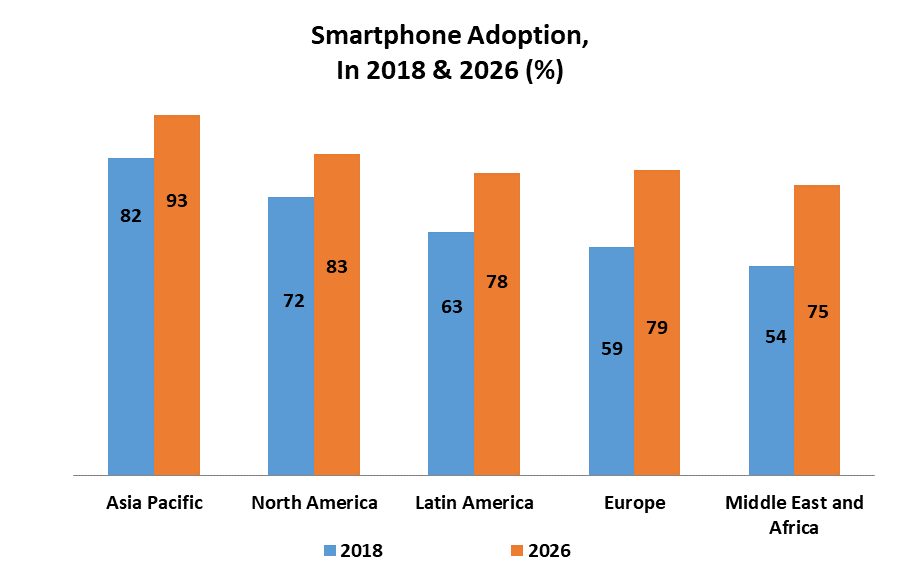
Global Social Commerce Market Segment Analysis:
Based on the business model, the global social commerce market is sub-segmented into Business to Consumer (B2C), Business to Business (B2B), and Consumer to Consumer (C2C). The B2C segment held the largest market share of 53.0% in 2020, and it helps to remove the third-party client and makes business administration easier. Customers can view, choose, and order a product while comparing the same-basis evaluations left by other users on social commerce sites. Furthermore, because the business-to-consumer model does not involve an intermediary, customers can obtain products at a low cost, allowing businesses to spend more on promotional advertising and order fulfillment. The Business to Business (B2B) segment held a market share of 35% in 2020. The social commerce industry is expected to grow as digitization spreads across many industries and business patterns shift to social media platforms. 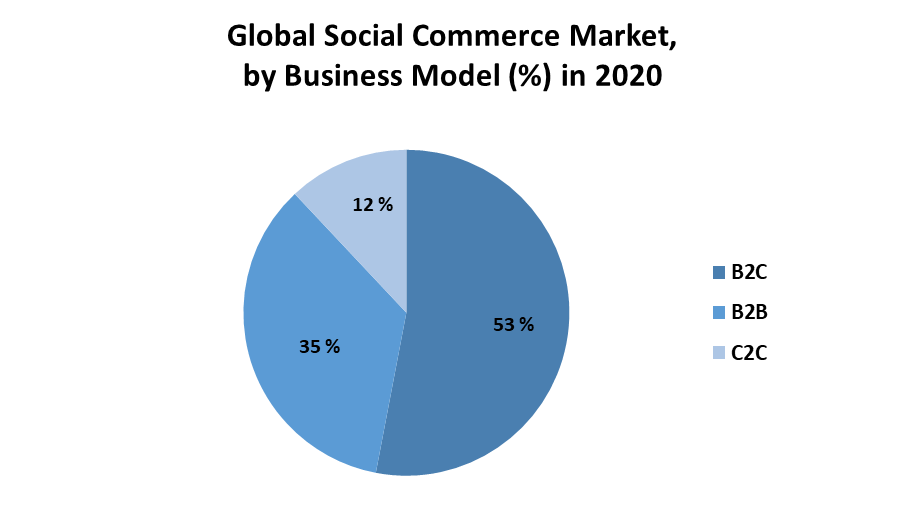 Based on product type, the global social commerce market is sub-segmented into Personal & Beauty Care, Apparel, Accessories, Home Products, Health Supplements, Food & Beverage, Others. The apparel segment held the largest market share of 23.69% in 2020. On social media sites, apparel is one of the most popular selling products. This market has a large number of vendors for selling apparel. Due to the COVID-19 pandemic, customers spent more time online and tried new social commerce shopping platforms. Furthermore, numerous sites offered discounts, free shipping, and exchange offers to entice clients during the lockdown.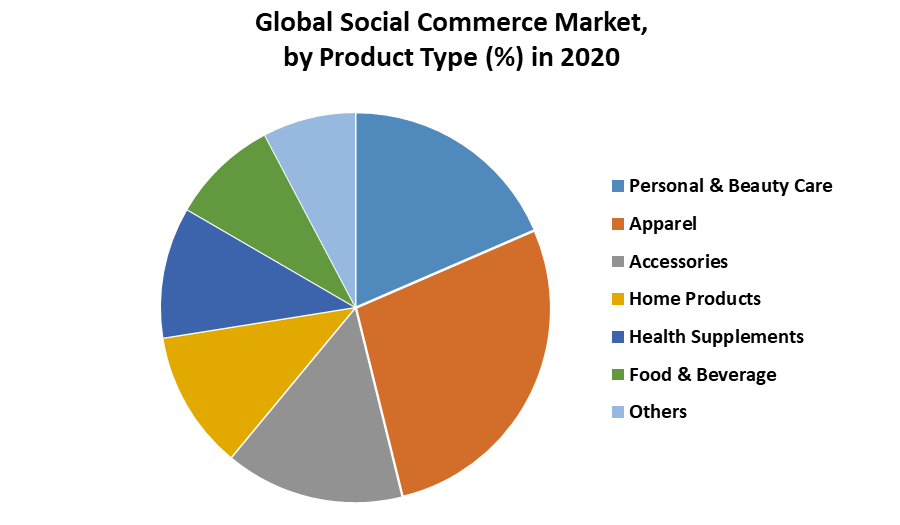
Global Social Commerce Market Regional Insights:
The Asia-Pacific region held the largest revenue share of 68.4% in 2020. Factors driving the regional market’s growth include increased investment in telecommunications infrastructure, increased demand for smartphones, and the widespread coverage of social media sites such as Facebook, Twitter, and Instagram. The growing number of smartphone and social media users in countries like China and India is mainly conducive to the regional market’s growth. In 2020, the North American market occupied a considerable share of global market demand. North America is one of the regions with the highest Internet penetration rate in the world. In addition, due to the COVID-19 pandemic, the time users spend on social media in 2020 has increased dramatically, creating market growth opportunities. 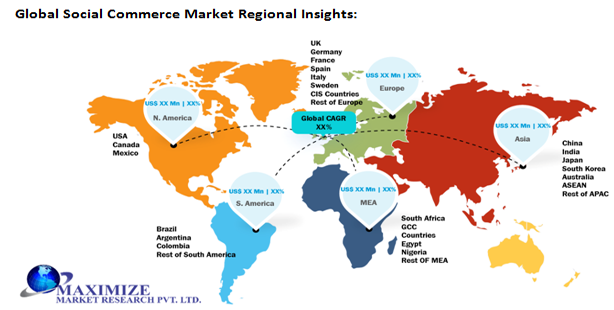
Recent Development:
• In Nov 2020, Facebook announced that it had signed an agreement to acquire customer, which specializes in chat-bots and customer services platform, as a result it helps company to use face book to do business. The objective of the report is to present a comprehensive analysis of the global Social Commerce market to the stakeholders in the industry. The past and current status of the industry with the forecasted market size and trends are presented in the report with the analysis of complicated data in simple language. The report covers all the aspects of the industry with a dedicated study of key players that include market leaders, followers, and new entrants. PORTER, PESTEL analysis with the potential impact of micro-economic factors of the market has been presented in the report. External as well as internal factors that are supposed to affect the business positively or negatively have been analyzed, which will give a clear futuristic view of the industry to the decision-makers. The report also helps in understanding the global Social Commerce market dynamics, structure by analyzing the market segments and projects the global Social Commerce market size. Clear representation of competitive analysis of key players by product, price, financial position, product portfolio, growth strategies, and regional presence in the global Social Commerce market make the report investor’s guide.
Global Social Commerce Market Scope: Inquire before buying

Global Social Commerce Market, by Region
• North America • Europe • Asia Pacific • Middle East and Africa • South America
Global Social Commerce Market Key Players
• Etsy, Inc. • Fab • Facebook • PayPal Payments • Pinterest • Poshmark, Inc. • Reddit Inc. • SINA Corp. • Taobao • Twitter, Inc. • Alibaba (China) Co., Ltd. • iQIYI • LinkedIn Corporation • Renren, Inc. • Tencent – Qzone • Tencent Holdings Ltd. • Tumblr, Inc. • Weibo Corporation • Yahoo!, Inc.
Frequently Asked Questions:
1. Which region has the largest share in Global Social Commerce Market? Ans: Asia Pacific region holds the highest share in 2019. 2. What is the growth rate of Global Social Commerce Market? Ans: The Global Social Commerce Market is growing at a CAGR of 29.2 % during forecasting period 2021-2027. 3. What segments are covered in Global Social Commerce Market? Ans: Global Social Commerce market is segmented into business model, production type and Region. 4. Who are the key players in Global Social Commerce Market? Ans: The important key players in the Global Social Commerce market are – Etsy, Inc., Fab, Facebook, PayPal Payments, Pinterest, Poshmark, Inc., Reddit Inc., SINA Corp., Taobao ,Twitter, Inc., Alibaba (China) Co., Ltd., iQIYI, LinkedIn Corporation, Renren, Inc., Tencent – Qzone, Tencent Holdings Ltd., Tumblr, Inc., Weibo Corporation, Yahoo Inc. 5. What is the study period of this market? Ans: The Global Social Commerce market is studied from 2019 to 2027.