Global Animal Feed Additives Market size was valued at US$ 16.36 Bn. in 2020 and the total revenue is expected to grow at 5.5% CAGR through 2021 to 2027, reaching nearly US$ 23.8 Bn.
Global Animal Feed Additives Market Overview:
Growing meat consumption, combined with recent disease outbreaks, has created a demand for additives in poultry, aquaculture, and other animal-based goods, which is likely to drive product demand. Additives are components that are essential for improving animal performance as well as their health. As a result, these products have an indirect impact on human food product features. Animals benefit from the consumption of food with a sufficient amount of additives, such as improved digestion and reproduction. 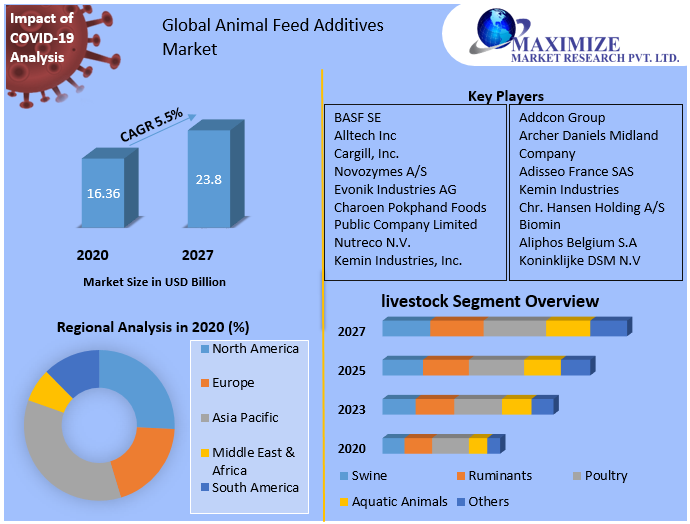 To know about the Research Methodology :- Request Free Sample Report 2020 is considered as a base year to forecast the Market from 2021 to 2027. 2020’s Market size is estimated on real numbers and outputs of the key players and major players across the globe. Past five years trends are considered while forecasting the Market through 2027. 2020 is a year of exception and analyzed specially with the impact of lockdown by region.
Global Animal Feed Additives Market Dynamics:
The use of feed additives in feed for the growth and development of farm animals is predicted to expand as demand for livestock-based products such as dairy and dairy-based products, meat, and eggs rises. Because of its great demand, cheap production costs, and reduced product pricing, poultry meat is the principal driver of overall meat production growth in both developed and developing countries. Furthermore, there is a growing trend toward animal-sourced protein in the form of meat, eggs, or milk, as people become more aware of the function and dynamics of food nutrients, particularly protein, on total physical and mental growth and development. Probiotics or direct-fed microbial are rapidly gaining popularity in the animal feed sector as the European Union prohibits the use of antibiotics in animal feed. Probiotics in animal feed help animals maintain good intestinal health, which improves their general productivity and well-being. As a result of population increase and improving living standards, the livestock business has been obliged to adapt and develop in order to satisfy society’s expectations. Consumers want meat-based products that are clean and safe. Manufacturers of animal feed additives will benefit from this.
Global Animal Feed Additives Market Segment Analysis:
Based on livestock, based on equipment the Animal Feed Additives market is segmented into Swine, Ruminants, Poultry, Aquatic Animals and Others. The poultry segment is expected to be the largest and fastest-growing section in the feed additives market, based on livestock. Increased demand for poultry feed additives has resulted from growing concerns about animal health and consumer demands for a specific hue of yolk and meat. As a result of the rise in diseases such as avian flu, stricter laws and standards have been implemented, driving greater demand for specialized chemicals. Furthermore, worldwide chicken meat production is predicted to grow at a rapid pace, resulting in increased demand for poultry feed over the forecast period. 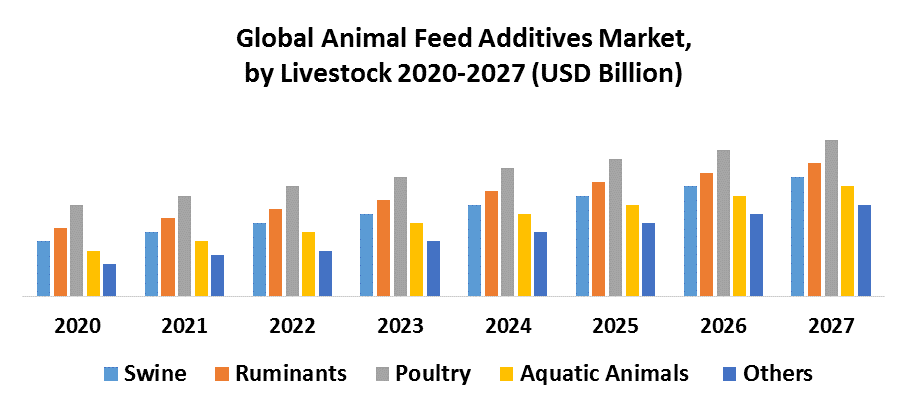 Based on form, Animal Feed Additives market is segmented into Dry, Liquid and Others. The dry segment is more popular among animal producers since it is easier to mix with feed, store, and handle. Its availability in pellet and mash forms gives consumers more alternatives when it comes to mixing procedures, which should help this category flourish.
Global Animal Feed Additives Market Regional Insights:
In terms of region, the Asia Pacific is estimated to hold the largest share in the global animal feed additives market during the forecast period owing to growing consumption of animal products in this region. China, the world’s second largest economy, is expected to reach a market size of US$4.4 billion in 2026, with a compound annual growth rate of 6.2 % throughout the analysed period. Japan and Canada are two other important geographic markets, with forecasted growth rates of 3.4 % and 4.2 %, respectively, over the analysis period. The increasing influence of western lifestyle among the population and rapid urbanization is also expected to surge the global animal feed additives market growth during the expected period. Moreover, the rise in population coupled with the disposable income of middle-class consumers in this region, which is driving the global market growth in a positive way. North America is estimated to generate the highest CAGR in the global animal feed additives market during the forecast period due to high living standards in this region. In the United States, the market for animal feed additives is expected to reach US$2.8 billion by 2021. In the global market, the country currently holds a 20.43 % stake. In addition, increased disposable incomes of consumers and growing demand for the quality of meat among consumers in this region, which is also anticipated to drive the global market growth in the forecast period.  The objective of the report is to present a comprehensive analysis of the Global Animal Feed Additives Market to the stakeholders in the industry. The past and current status of the industry with the forecasted Market size and trends are presented in the report with the analysis of complicated data in simple language. The report covers all the aspects of the industry with a dedicated study of key players that include Market leaders, followers, and new entrants. PORTER, PESTEL analysis with the potential impact of micro-economic factors of the Market have been presented in the report. External as well as internal factors that are supposed to affect the business positively or negatively have been analyzed, which will give a clear futuristic view of the industry to the decision-makers. The report also helps in understanding the global market dynamics, structure by analyzing the Market segments and project the global market size. Clear representation of competitive analysis of key players by Type, price, financial position, Type portfolio, growth strategies, and regional presence in the global market make the report investor’s guide.
Global Animal Feed Additives Market Scope: Inquire before buying
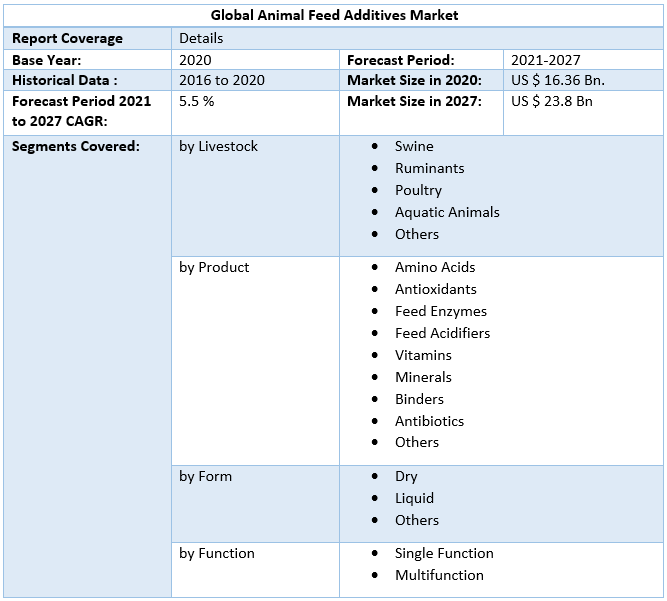
Global Animal Feed Additives Market, by Region
• North America • Europe • Asia Pacific • Middle East and Africa • South America
Global Animal Feed Additives Market Key Players
• BASF SE • Alltech Inc • Cargill, Inc. • Novozymes A/S • Evonik Industries AG • Charoen Pokphand Foods Public Company Limited • Nutreco N.V. • Addcon Group • Archer Daniels Midland Company • Adisseo France SAS • Kemin Industries • Chr. Hansen Holding A/S • Biomin • Aliphos Belgium S.A • Koninklijke DSM N.V • Phibro Animal Health Corporation • Biotech JSC • Danisco Animal Nutrition, Biomin, • Ajinomoto Co., Inc. • Adisseo France SAS. • Kemin Industries, Inc. Frequently Asked Questions: 1] What segments are covered in Global Animal Feed Additives Market report? Ans. The segments covered in global market report are based on Livestock, Product, Form and Function. 2] Which region is expected to hold the highest share in the Global Animal Feed Additives Market? Ans. Asia Pacific is expected to hold the highest share in the Animal Feed Additives Market. 3] What is the Market size of Global Animal Feed Additives Market in 2027? Ans. The Market size of Global Animal Feed Additives Market in the forecast period 2027 is US $ 23.8 Bn. 4] Who are the top key players in the Global Animal Feed Additives Market? Ans. BASF SE, Alltech Inc, Cargill, Novozymes A/S, Evonik Industries AG, Charoen Pokphand Foods Public Company Limited, Nutreco N.V., Addcon Group, Archer Daniels Midland Company, Adisseo France SAS, Kemin Industries, Chr. Hansen Holding A/S, Biomin, Aliphos Belgium S.A, Koninklijke DSM N.V, Phibro Animal Health Corporation, Biotech JSC, Danisco Animal Nutrition, Biomin, Ajinomoto Co., Adisseo France SAS. 5] What was the Market size of Global Animal Feed Additives Market in 2020? Ans. The Market size of Global Animal Feed Additives Market in 2020 was US $ 16.36 Bn.